Case Study: Structural Collapse in a Two‑Frame Political Exchange
A UPC–QM Analysis of Meaning Collapse

Introduction
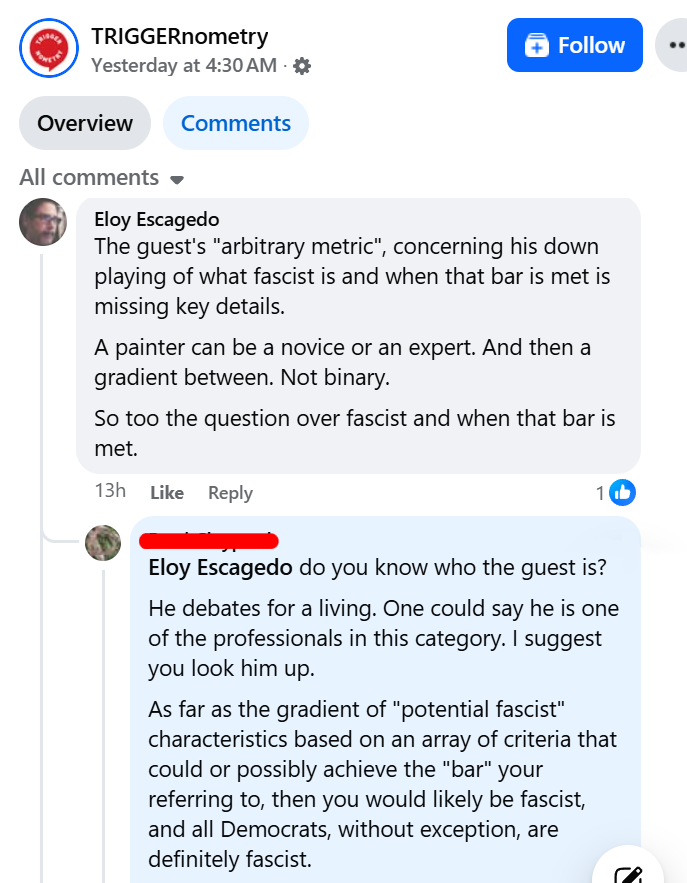
The exchange below took place in the comment section of a TRIGGERnometry video clip, where the guest discussed the definition of “fascism” and argued for a narrow threshold for when the term applies. The clip framed the concept as something often misused or exaggerated, which prompted a discussion in the comments about how political categories function and whether they should be treated as binary or gradient‑based.
What follows is the comment thread between myself and another viewer. I raised a point about categorical nuance, while the other commenter reframed the discussion into a partisan argument. After the exchange, I provide a brief meta‑analysis of where the framing shifted and how the argument structure broke down.
A final note before entering the exchange: this case study also serves as a demonstration of how such conversational divergences can now be formally documented using the UPC–QM Bridge. Under this framework, each participant engages the same external topic through their own observer‑relative Potential (PO), shaped by their internal Model (MO) and salience gradients. Even when the subject appears shared, the articulation bases applied to that subject may be structurally incompatible, producing collapse outcomes that are internally coherent yet mutually irreconcilable. The exchange below illustrates this mechanism in practice: two participants responding to the same clip, but operating from different salience structures, different articulation frames, and therefore different stabilized interpretations. Readers interested in the formal operator chain and the structural account of how meaning and language can be analyzed with the same rigor as quantum measurement can consult The UPC–QM Bridge: A Structural Account of Political Disagreement for a full treatment.
The Thread
Eloy:
The guest’s “arbitrary metric”, concerning his down playing of what fascist is and when that bar is met is missing key details.
A painter can be a novice or an expert. And then a gradient between. Not binary.
So too the question over fascist and when that bar is met.
User:
do you know who the guest is?
He debates for a living. One could say he is one of the professionals in this category. I suggest you look him up.
As far as the gradient of “potential fascist” characteristics based on an array of criteria that could or possibly achieve the “bar” your referring to, then you would likely be fascist, and all Democrats, without exception, are definitely fascist.
Example:
Key Characteristics of a Fascist/Fascism:
Dictatorial Power: Belief in a strong, charismatic leader and a single-party state.
Obama/Clinton (no one but them)
Extreme Obsession with national decline, humiliation, or victimhood, seeking a “rebirth”.
Constant victims!!
Suppression of Dissent: Strict censorship and violent suppression of political opponents or critics.
This is without a doubt THE defining characteristic of the left!!
See? pretty easy to do if you just want to cherry pick the attributes.
Eloy:
Well, I will answer both the “who the speaker is” and the “everyone is therefore fascist” positions.
One. Who the speaking in the clip is and your claim of his authority is a plead to authority. That is cult of personality and surrender of correctness based on fame and title. The placement of preference over substance.
Two. Now, concerning your “everyone is fascist” bit. Correct. The term fascist is a placeholder. And you can apply it as a gradient. There is a scale.
Your choice in applying it to scenarios that drift from the accepted and anchored definition, the less people may choose to certify your claim as valid.
This is why during the Nuremberg trials different participants were sentenced differently according to their participation.
Notice what I have performed in reply to your objections. I named the plead to authority/popularity. I explained that words and definitions are agreed on definitions. And that those work in reality as gradients dependent on the surrounding context. And finally, I gave you a direct real world example through the Nuremberg trials.
Recap
In this case study the other participant’s framing collapsed into their preferences. Both they and I were operating from our own internal models (MO). They were delivering a partisan framing while I was concerned with the structural frame. The topic served as the tentative anchor that brought us into the exchange, but we were effectively having two different conversations. This is how meaning between participants can appear aligned on the surface while the underlying concerns diverge.
While they may have further reasons for applying the examples they did, I could only address what was presented. And since my intention was a structural review of the main post, treating the term “fascist” as a gradient rather than a binary, my replies stayed aligned with that aim while addressing the User’s additional critique. My position remained anchored to the structure, not the partisan drift.
To recap: their first collapse was the appeal to authority, “look him up, he debates for a living”, a shift from substance to personality, a substitution of title for argument. The second collapse was the leap to “then everyone is fascist,” which misapplied the gradient and flattened nuance into a partisan caricature. The third collapse was the cherry‑picking of traits to force a predetermined conclusion, revealing the absence of an anchored definition. By naming the appeal to authority, re‑establishing that definitions are socially anchored gradients, and grounding the point with a real‑world example like the differentiated sentencing at Nuremberg, the structure of the exchange becomes visible. Once the conversation left the shared frame of definitions and slid into identity‑based reasoning, coherence buckled. That is the clarity this case study exposes.
Structural Note: The UPC–QM Bridge and This Case Study
The exchange analyzed in this case study can now be situated within the formal structure provided by the UPC–QM Bridge. In the UPC framework, each participant engages the same external topic through their own observer‑relative Potential (PO), shaped by their internal Model (MO) and salience gradients (s). Although the clip and the term “fascist” served as the shared external anchor, the two of us articulated that domain in incompatible bases. My framing operated through a structural LO basis concerned with category‑shape, gradient behavior, and definitional anchoring. The other participant articulated the same external topic through a partisan LO basis, where salience was assigned to identity‑linked threat models and group‑level narratives. These articulation bases were non‑commuting, and the collapse outcomes reflected that incompatibility.
In UPC terms, the disagreement did not originate at the level of beliefs or evidence. It emerged earlier, in the divergence of salience gradients and articulation structures. My replies were generated within a structural MO that foregrounded definitional clarity and gradient‑based category behavior. Their replies were generated within a partisan MO that foregrounded authority signals, group‑threat cues, and identity‑linked salience. Because the LO bases were incompatible, the Recognition Operators (Jo) stabilized different structures, and the Collapse Operators (C) produced mutually exclusive interpretations. The coherence of each position was internal to its own operator chain, not shared across them.
This short section is only a brief application of the UPC–QM Bridge to the case study. Readers who wish to see the full formalism, including the operator chain, basis‑incompatibility diagrams, and the geometric account of salience and collapse, can consult the paper The UPC–QM Bridge: A Structural Account of Political Disagreement, where the mechanism underlying meaning, language, and political divergence is developed in detail.
For the formal operator chain, equation audits, and full multi-disciplinary case studies across physics, AI, and human meaning, consult the complete framework architecture at the UPC Research Project Central Repository.