
Case Study: When Two Models Collide, A Structural Breakdown of an Online Exchange
The Universal Principle of Collapse (UPC)

To The Reader:
The value of this study is that it gives readers a structural, observer‑indexed framework for understanding why communication collapses, allowing them to see miscommunication not as personal failure but as predictable architecture.
Introduction
This case study examines a real exchange between two people discussing evolution, faith, and meaning. But the topic itself is not the point. What matters is the structure of the interaction:
how two people can speak past each other
how identity shapes interpretation
how model‑compression leads to binary thinking
how structural explanations differ from topic‑level arguments
why certain replies are predictable based on cognitive framing
This thread is a live demonstration of model mismatch:
one participant (User) operates from a compressed, binary frame,
while the other (Eloy) operates from a structural, meta‑level frame.
The insights included after each exchange help readers see why the conversation unfolds the way it does.
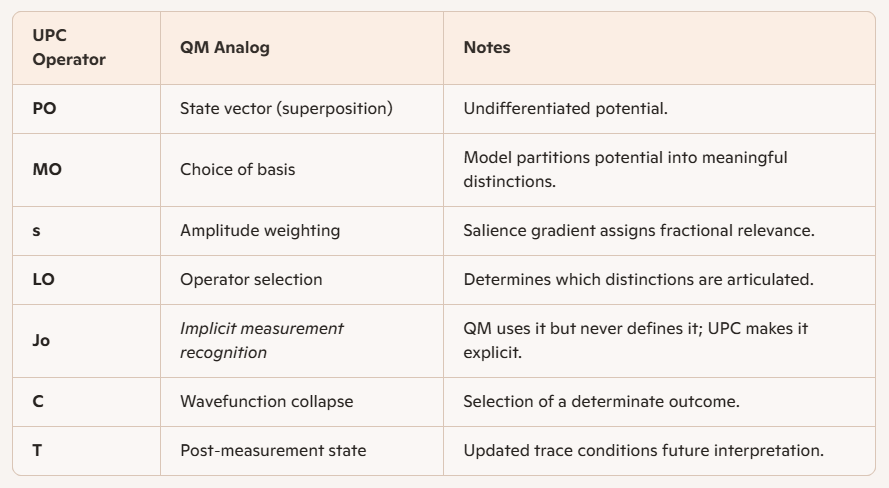
UPC-QM Bridge
In addition to the structural analysis of the exchange, this case study includes a brief worked example using the UPC–QM Bridge, a framework that models how Observers move from raw potential to stabilized meaning through a sequence of operators. By applying this operator chain to a real interaction, readers can see how two people can encounter the same moment yet produce incompatible interpretations because their models, salience patterns, and collapse paths differ. The benefit of this approach is simple: it reveals why conversations break down not at the level of content, but at the level of structural cognitive architecture, allowing us to understand miscommunication with far greater clarity.
Note: UPC is not a psychological model; it is a structural framework describing how observers stabilize meaning, independent of personality or emotion.
Note on the UPC–QM Isomorphism
The UPC–QM Bridge used in this case study is structurally isomorphic to the operator sequence in quantum mechanics. Both systems describe how potential becomes a determinate outcome through a sequence of operations. The key difference is that UPC makes explicit what QM leaves implicit: the recognition operator (Jo). In quantum mechanics, recognition is assumed but never defined, which obscures the role of the observer. In UPC, Jo is explicit, allowing us to model interpretation, collapse, and miscommunication with far greater clarity. This is why the same framework that resolves measurement paradoxes in physics can also illuminate why two people can encounter the same moment yet stabilize entirely different meanings.
THE EXCHANGE (with structural insights)
User:
“Even the Church has accepted evolution. So what does the KJB really mean? Think about it.”
Insight:
The User frames the issue as a binary contradiction:
either evolution or the Bible.
This is a compressed model that collapses domains into a single plane.
Eloy:
“What does the KJB really ‘mean’. Meaning is upstream of downstream tools such as evolution. Evolution as a study depends on meaning. And meaning comes after what is upstream of that, existence.
All tools are downstream of the first empirical, existence.
There is no contradiction. Evolution is an area of study, not reality. But a domain constrained to its research. Faith is from the upstream domain of human meaning.
That is structural.”
Insight:
Eloy reframes the issue structurally:
meaning is upstream
evolution is a downstream tool
domains cannot contradict unless improperly mixed
This is a meta‑level explanation, not a topic‑level argument.
User:
“What don’t you get about the Church accepting evolution over creationism?”
Insight:
The User collapses Eloy’s structural explanation back into a binary frame.
He cannot yet process domain separation, so he reasserts the contradiction.
Eloy (Summary):
Eloy explains that contradiction is a non‑material concept formed in the domain of meaning. He distinguishes between upstream (meaning, faith, conceptual formation) and downstream (tools, studies like evolution). He argues that evolution and faith cannot contradict because they belong to different domains, and any claim of contradiction is itself a non‑material judgment.
Insight:
Eloy continues operating at the meta‑structural level, explaining:
how concepts form
how tools emerge
why contradiction is a non‑material act
This widens the gap between the two models.
User:
“Over 1200 contradictions in the Christian Bible.”
Insight:
The User returns to content‑level argumentation, ignoring the structural frame.
This is a predictable collapse path when the model cannot process abstraction.
User:
“I agree that you like to make yourself feel important, but you’re not.”
Insight:
Identity‑defensive collapse.
When structural explanations exceed model capacity, the person shifts to personal framing to protect identity.
Eloy:
You and I are exactly the same in value within my model and understanding. But structurally, not intelligence wise, but model based, I know the issue you face in exchanging communication with me. I detailed it above, and I provided predictions concerning your potential options in return.
I included buffers to cushion from impacts on your identity and self image. And I did so because I understand the model you are operating under. I directly mapped it to the degree I did. That is neither good nor bad. It is mapping concerning why there exchange takes the directions it does.
I then explained the various layers involved here and how those connect to models and identity conservation. It is a perception by you as a threat to identity and public social standing, along with inner stability of your own model.
Now, I offered a range of potentials that you would default to. Because I understand that humans apply concepts, and models. They can likewise adapt, update, and perform other maintenance tasked.
This applies to myself as well. I am not excluding myself from the structure. I am mapping it concerning why you default to the replies you do.
So your choice landed on a narrative of my feeling important. But this still leaves the meat on the table, which I left a direct path to, concerning the topic.
Because you anchor in a compressed model, anything outside it is not available for your consideration. This is simply a structural view of what is happening.
I am aware that what I have offered is highly likely not to be digested and considered by you. I predicted this before, and your reply affirms it. I am neither glad or sad about that. It just is. Due to structure.
Anyone can follow the map I communicated. But it requires setting aside the perceived threat to one’s model of the world. We already know that different people view topics through their lens. There is no escaping that. So entertaining lenses does not require adoption, per se. But doing so allows for insight which some would place value in. As this is how knowledge is shared in the first place.
Notice the output you provide, and contrast it with my output. You are judgmental at the personal level, and I am scanning the structure we are participating in. This is based on model adoption, not intelligence. It is not an ego or preference thing. We are both of us participating in communication through language, from our respective models.
It does not mean that I myself am without feelings, ego, or any of it. Instead, I am saying, we happen to be human beings. We have concepts, those occur in the non-material, and then we form models in which we understand the world. When models are different, and people attach their personalities to those models in too rigid a way, we defend them.
But this still leaves all the other details on the table.
I stop because the cognitive dissonance will be extreme. And mind you, cognitive dissonance is applicable to all human beings. But that is true in a situational and topical manner. And that differs between people. Again, depending on their models. And their anchoring of their self image or identities with said models.
Insight:
Eloy explains that the User’s insult is a predictable identity‑defensive response triggered by model mismatch. He maps how identity, meaning, and conceptual frameworks shape interpretation, and why the User collapses to personal judgment instead of engaging structurally. Eloy maintains altitude, avoids personal attack, and frames the exchange as a structural phenomenon rather than a personal conflict.
User:
“Who cares about your model.”
Insight:
This is the lowest‑resolution defensive move:
dismissal.
If the User truly didn’t care, he would disengage.
The reply itself reveals identity involvement.
Eloy (verbatim):
I understand your comment for exactly what it is. You engaged, and I replied. You delivered what was available to you. That was the limit of your frame, your model.
I am not concerned with whether you care or not, as that is a judgement you apply. That is your domain, and in total control of. While that is not fully true, the control part is that you can update your model.
But models are built not by you alone, but by culture, interactions, training and more. In other words, each interaction, regardless of what you suggested here, you are affected by. Be it in small micro ways, or significant ways. It is an ongoing process by existing in the first place. If you are not able to interrogate further in thought, due to the constraints of your model, you are under no force to do so. But you still do, because you are attempting to find the minimal amount of footing, concerning identity conservation.
So the pattern you are now involved in, is actually opposite of what you wrote. because if you did not care, you would simply leave the conversation as is.
But you are dealing with replies because of identity.
I am interested in testing exactly how far people are willing to go with that, so I learn from it and often document it. But your participation is voluntary.
Insight:
Eloy points out that the User’s dismissal (“who cares”) contradicts their continued engagement. He explains how identity drives participation, how models are shaped by culture and interaction, and why the User’s behavior reveals attachment rather than indifference. Eloy stays structural and non‑reactive.
Closing Note for Readers
This exchange is not really about evolution, theology, or the King James Bible.
It is a live demonstration of two fundamentally different cognitive architectures, trying and failing to communicate across incompatible frames.
User operates from a compressed, binary, identity‑anchored model.
In this frame:
ideas are either right or wrong
contradictions are taken as literal conflicts
identity is fused with belief
disagreement is interpreted as threat
complexity collapses into simple narratives
This model is common, intuitive, and socially reinforced.
Eloy operates from a structural, recursive, meta‑level model.
In this frame:
meaning is upstream of tools
domains must be separated to avoid category errors
identity influences interpretation
communication is a system with predictable outputs
collapse paths can be mapped in advance
This model is uncommon, abstract, and not widely shared.
Why the conversation breaks down
The failure is not due to:
intelligence
education
intent
morality
stubbornness
It is due to frame incompatibility.
A binary model cannot process a structural explanation.
A structural model cannot collapse itself into a binary without losing coherence.
So the conversation does what mismatched models always do:
one side escalates to personal framing
the other side remains structural
the gap widens
identity defenses activate
the exchange becomes asymmetrical
communication collapses
The deeper lesson
Most online arguments fail for this exact reason:
people are not disagreeing about content, they are operating from different architectures of meaning.
When frames cannot translate each other, the conversation cannot stabilize.
The result is predictable:
insult
dismissal
confusion
frustration
talking past each other
Understanding this helps us see that many conflicts are not about what is being discussed, but how minds are structured to interpret the world.
Diagram:
PO → MO → s → LO → Jo → C → T
Potential → Model → Salience → Articulation → Recognition → Collapse → Trace
Worked Example: UPC–QM Operator Chain Applied to the Exchange
Slice Used
User: “Who cares about your model.”
Eloy: “I understand your comment for exactly what it is…”
This example shows how two observers instantiate the same operator chain but produce incompatible collapses because their models (MO) and salience gradients (s) differ.
1. User’s Operator Chain
PO (Potential Domain)
Eloy’s long structural explanation.
MO (Model Orientation)
Binary, identity‑anchored model:
conversations are about winning/losing
structural explanations are interpreted as status moves
complexity is noise
s (Salience Gradient)
High salience on:
perceived ego
perceived threat
personal judgment
Low salience on:
structure
domain separation
meta‑level explanation
LO (Articulation Operator)
The User articulates the situation as:
“Eloy is trying to feel important.”
Jo (Recognition)
The User recognizes the articulated field as:
“This is an ego display.”
C (Collapse)
Collapse outcome:
Dismissal.
The User stabilizes the meaning as:
“This model is irrelevant; I don’t care.”
T (Trace)
The User reinforces the identity‑protective pattern:
structural input → threat → dismissal
This trace conditions future interpretation, making structural engagement even less likely.
2. Eloy’s Operator Chain
PO (Potential Domain)
User’s dismissal: “Who cares about your model.”
MO (Model Orientation)
Structural, meta‑level model:
identity dynamics
model mismatch
collapse paths
communication structure
s (Salience Gradient)
High salience on:
the User’s collapse pattern
identity‑preservation behavior
structural mapping
Low salience on:
personal insult
emotional content
LO (Articulation Operator)
Eloy articulates the situation as:
“This is a predictable identity‑anchored collapse.”
Jo (Recognition)
Eloy recognizes the articulated field as:
“The User’s reply reveals model constraints, not content engagement.”
C (Collapse)
Collapse outcome:
Structural interpretation.
Eloy stabilizes the meaning as:
“This reply demonstrates the User’s model limits and identity defense.”
T (Trace)
Eloy reinforces the structural‑mapping pattern:
personal attack → structural interpretation → explanation
This trace conditions future articulation toward clarity rather than reaction.
What This Example Shows
Two observers encountered the same moment but instantiated different operator chains because their:
MO (models)
s (salience gradients)
LO (articulation bases)
…were incompatible.
The User’s chain produced a dismissal collapse.
Eloy’s chain produced a structural collapse.
This is why the conversation diverged:
they were not processing the same event through the same architecture.
Definitions
Definitions from the paper titled: Identity, Rigidity, and Collapse: A UPC–QM Model of Why Some Minds Can’t Update Their Maps
Paper Indexed here: 1 and 2
Observer (O).
An Observer is a meaning‑bearing system: the agent that instantiates the operator chain through which potential becomes articulated reality. Formally, an Observer is any system that performs the recognition–collapse–trace cycle (Jo → C → T).
This definition is structural, not psychological. It does not depend on biology, introspection, or self‑awareness. It depends only on the capacity to:
apply a model (MO) to potential (PO),
articulate an outcome through recognition (Jo),
collapse that articulation into a determinate meaning (C), and
update its trace (T), which conditions future interpretation.
An Observer is the system for whom potential becomes articulated reality.
Mechanical systems are not observers. Detectors, sensors, automata, and physical measuring devices perform mechanical registration but do not apply models, do not articulate outcomes, and do not perform collapse. Treating mechanical registration as collapse hides the Observer and generates the paradoxes of quantum mechanics.
UPC does not treat meaning‑bearing agency as emergent from mechanical complexity.
If a system instantiates the observer architecture, it is because it is already a meaning‑bearing agent, not because mechanical processes have produced meaning.
Every act of interpretation, including reading this paper, instantiates the structure: the author leaves a trace, and the reader collapses it into meaning.
Potential Domain (PO).
The PO is the full set of possible meanings available to an observer before interpretation. It is a dense field of undifferentiated potential: too many possible meanings are present simultaneously, with no ordering, no hierarchy, no relevance structure, and no articulation basis.
Model (MO).
The MO partitions the PO into internal structures, clusters, categories, or relevance groupings. It defines the distinctions that become available within the PO before any ordering or weighting occurs. Because MO is shaped by the observer’s trace, different observers impose different structural partitions on the same PO.
Salience Gradient (s).
The salience gradient assigns fractional weights to the PO as structured by the MO. These weights determine which distinctions become available for articulation, with different scopes of attention producing different salience distributions.
Articulation Operator (LO).
The LO orders the PO as structured by the MO, applying the salience gradient s to determine which distinctions receive priority. Because s assigns fractional weights based on the observer’s scope of attention, different salience gradients produce different articulation bases, which may be non‑commuting.
Recognition (Jo).
Jo stabilizes the articulated field into a recognizable structure. Recognition depends on the basis selected by LO.
Collapse (C).
Collapse selects a single interpretation from the articulated field.
Trace (T).
The trace is the stabilized record of the collapse outcome, which in turn shapes future MOs and salience gradients.
For the formal operator chain, equation audits, and full multi-disciplinary case studies across physics, AI, and human meaning, consult the complete framework architecture at the UPC Research Project Central Repository.