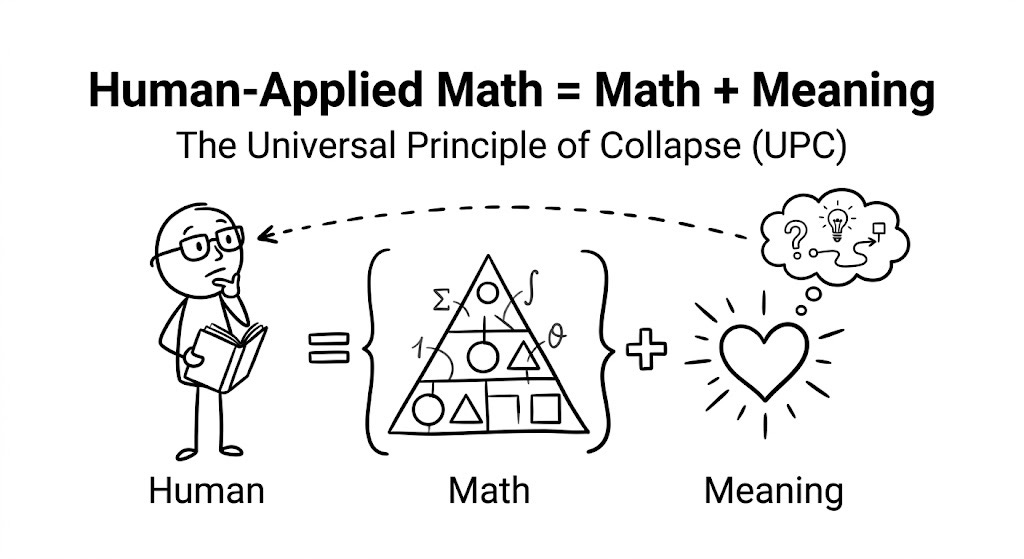
Human‑Applied Math = Math + Meaning
The Universal Principle of Collapse (UPC)

Math does not equal meaning.
Math = math.
Human‑applied math = math + meaning.
Structural order:
Existence → Conceptualization → math‑tool → application → results → Human‑indexed meaning
Often, some assume, implicitly or otherwise:
math = reality
models = ontology
measurement = the thing measured
observer = irrelevant
Usually these assumptions might not be stated explicitly.
But they are inherited habits, and conceptual defaults.
This is why:
physicists talk about “spacetime bending”
cognitive scientists talk about “information processing” as if meaning were mechanical
philosophers argue about “objective reality” as if objectivity were a substance
institutions treat models as if they were the world
These are category errors, not scientific conclusions. Instead, they are interpretive layers applied on top of data. They are also linguistic compressions.
Mathematics is a human‑constructed formal tool with fixed rules; it does not carry meaning by itself.
What the UPC–QM Bridge Provides
The UPC–QM Bridge is a structural mapping that aligns the quantum‑mechanical measurement sequence with the UPC operator chain, showing that both rely on the same underlying operations: distinguishing, recognition, and collapse. Quantum mechanics already formalizes PO, MO, s, LO, C, and T, but leaves Jo, the recognition operator, implicit. The Bridge makes this missing step explicit and shows that measurement is not a mysterious physical event but the same structural act of recognition that stabilizes meaning in any domain. This restores the Observer as a formal requirement rather than a metaphysical add‑on and prevents mechanical registration from being mistaken for collapse.
The key move UPC makes is applying identity‑level rigor to the meaning‑layer itself. Mathematics is internally consistent because math = math, and UPC shows that meaning formation follows an equally strict structure: no interpretation stabilizes without passing through PO → MO → s → LO → Jo → C → T. This exposes that scientific and philosophical models cannot bypass the Observer, because the act of modeling already requires Jo → C. The implication is that many long‑standing paradoxes, quantum measurement puzzles, reified spacetime, “flowing time,” and model‑as‑ontology errors, arise from omitting Jo or collapsing the world, the observer, and the model into one layer. The UPC–QM Bridge resolves these issues by keeping the layers distinct and making the full operator chain explicit.
Worked Example: Applying the UPC–QM Bridge to a Meaning Exchange
This worked example applies the UPC operator chain to a simple conversation about whether mathematics is a “universal language.” Readers can reference the definitions section for details on PO, MO, s, LO, Jo, C, and T. The purpose is to show how meaning stabilizes through the UPC structure and why two people can disagree even when discussing a shared tool like mathematics.
In the thread, User 1 states: “Mathematics is a universal language.” Eloy responds by noting that communication tools, math, music, art, produce traces that must be interpreted by meaning‑bearing agents. Mathematics is a human‑constructed tool with fixed rules, but understanding those rules is not universal across observers. If an interpreter does not know the rules of the system, the communication is not universal in practice. The term “universal” is therefore model‑dependent: each observer partitions the concept differently within their MO. Eloy points out that if the speaker had communicated only in mathematical notation, many readers would not understand the message, which contradicts the claim of universality. This shows two observers applying different models to the same term and producing different collapses.
To close the example, we note that language is a tool, and definitions vary by context. Each participant observes only the other’s trace and must run their own UPC chain to interpret it. Meaning is individually indexed, but this is not relativism or solipsism: the world exists, the participants exist, and mathematics exists as a shared formal system with human‑defined rules. What differs is how each observer partitions the term “universal” within their own model. Each person forms a model of the other’s model, and the conversation proceeds as an exchange of traces interpreted through separate windows. This explains why disagreements arise even when the underlying tools are shared.
The UPC-QM Bridge Operator Chain (Easy Intuitive Overview)
Observer (O)
An Observer is a meaning‑bearing agent: a system capable of applying a model to potential and articulating an outcome. Formally, an Observer is any system that instantiates the full cycle:
PO → MO → s → LO → Jo → C → T
This definition is structural, not psychological.
Jo and C are structural operators in the UPC chain. Humans instantiate these operators because humans carry meaning, but the operators themselves are formal and substrate‑independent, in the same way that arithmetic, logic, and language are formal even though humans enact them.
It does not depend on biology, introspection, or self‑awareness.
It depends only on the capacity to interpret information within a model (MO) and to articulate a unique outcome (Jo → C).
An Observer is the entity for whom potential becomes articulated reality.
Mechanical systems are not observers.
Detectors, sensors, automata, and physical measuring devices perform mechanical registration but do not apply models, do not articulate outcomes, and do not perform collapse.
Attempts to replace observers with mechanical devices do not eliminate collapse; they merely defer it.
Treating mechanical registration as collapse hides the Observer and generates the paradoxes of quantum mechanics.
UPC does not treat meaning‑bearing agency as emergent from mechanical complexity.
If a system instantiates the observer architecture, it is because it is already a meaning‑bearing agent, not because mechanical processes have produced meaning.
UPC allows that meaning‑bearing agents may differ in their models and may adopt paradoxes according to those models, but it does not assume that mechanical systems can become observers.
An Observer is not defined by what it is made of, but by what it does structurally.
Definitions. The operator chain below provides a simple, intuitive overview version of the UPC-QM Bridge structure:
PO (potential): what could be
The full field of potentials: sensory, conceptual, emotional, imaginal.
Not yet structured or chosen, simply available.
MO (model): how possibilities are partitioned
The first shaping of the field: a stance, frame, or direction that organizes the potentials.
s (salience): what is weighted as likely / foregrounded
A narrowing of attention. One path or hypothesis becomes favored.
LO (articulation): what becomes expressible structure
The selected material is organized into a coherent pattern or form.
Jo (recognition): what becomes selected as “this”
The moment of recognition or collapse: “this one.”
A specific meaning or outcome is singled out.
C (collapse): what becomes fixed / exclusive
The stabilized interpretation or concept.
A meaning that now excludes alternatives.
T (trace): what becomes persisting record
The external residue: words, actions, data, artifacts, memory traces.
Relation to Quantum Mechanics
Quantum mechanics already formalizes much of this chain:
PO — the state vector, amplitudes, superpositions
MO — the choice of observable
s — basis selection
LO — the measurement apparatus and eigenstructure
C — the commitment to a definite meaning
T — record of that commitment
But Jo, the recognition operator, is treated implicitly or externally.
Primary And Secondary Empiricism
Primary Empiricism
The first and undeniable fact of reality: the conscious, experiencing inner being. All knowing, modeling, imagining, and interpreting arise from this non‑material domain. It is the empirical ground from which all other forms of inquiry derive.Secondary Empiricism
The downstream, third‑person domain of tools, measurements, and material data. Microscopes, sensors, and detectors operate within this boxed‑in subset of reality. Their outputs depend entirely on the conceptual and experiential capacities of the beings who designed them.'
Primary empiricism refers to the undeniable fact of experience, not a metaphysical claim.
Biological Domain
UPC is a structural model of meaning‑formation, not a biological or physiological model. It describes the invariant operator sequence an Observer performs when selecting meaning. Biology does not instantiate UPC operators; it provides the lived substrate in which observers act.
Bodily processes, neural activity, reflexes, metabolism, sensation, belong to the physical background. They are not PO, LO, Jo, or any operator in the chain. Humans drink coffee, walk, notice, and interpret; those meaning‑bearing moments can be modeled by UPC, but the bodily mechanics that support them cannot.
Domains such as biology, physics, and psychology are observer‑created partitions of experience. Meaning precedes these categories. Without this distinction, it is easy to mistake reactivity for recognition or treat biological events as if they were operators.
UPC applies at any scale because it isolates the structure of collapse from the physical setting in which it occurs. Micro‑bodily shifts may accompany experience, but they are not operators unless they stabilize into traces. Strip away every model and domain distinction, and the empirical remainder is simple: observers run the UPC chain; bodies do not.
Biology provides the substrate in which Observers act, but the UPC operators themselves are formal and secondary, arising only when a meaning‑bearing agent performs the structural sequence that biology alone cannot instantiate.
For the formal operator chain, equation audits, and full multi-disciplinary case studies across physics, AI, and human meaning, consult the complete framework architecture at the UPC Research Project Central Repository.