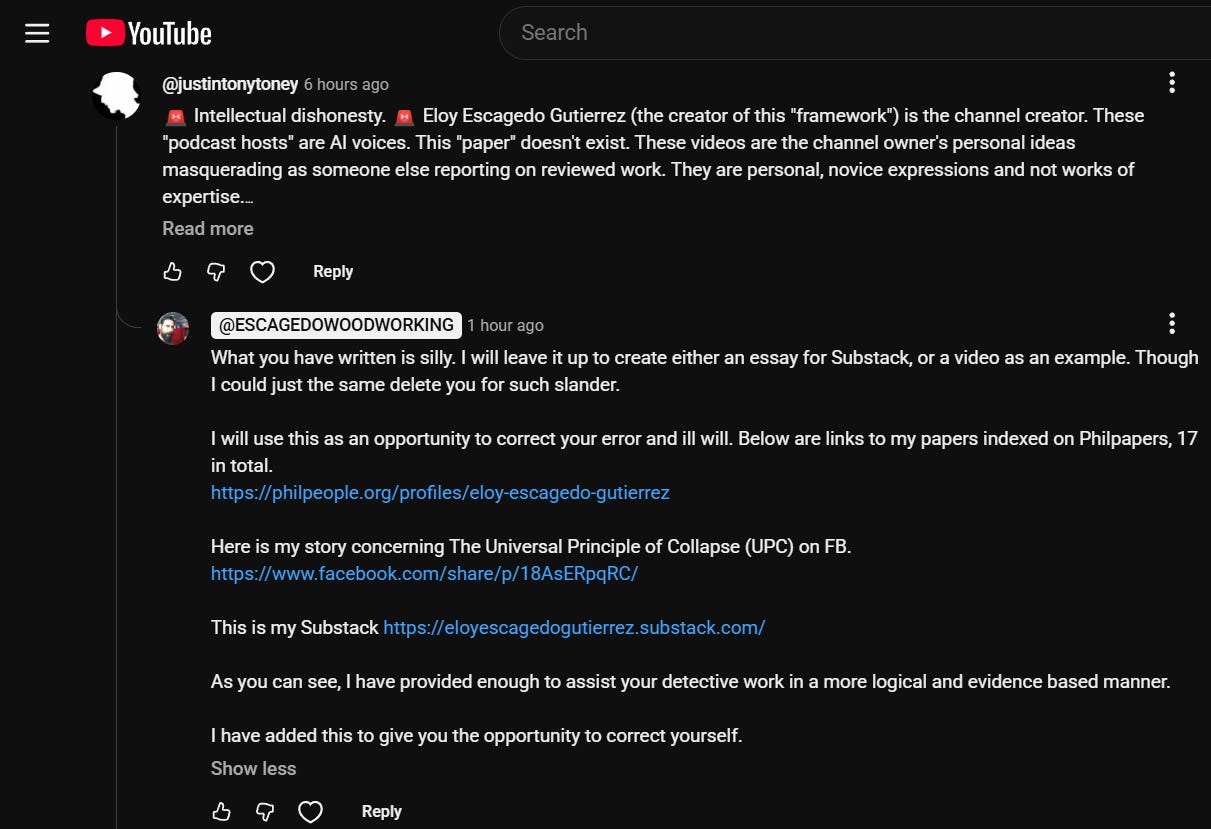
Miscommunication, Maps, and Collapse: A Real‑World Example of the UPC
The Universal Principle of Collapse (UPC)

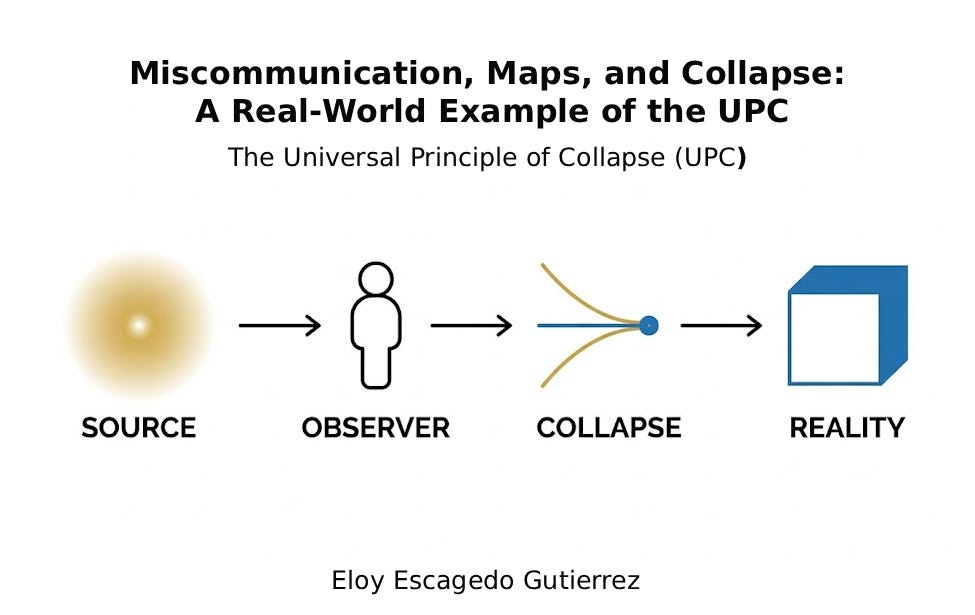
A recent comment on one of my videos accused me of dishonesty, not because of the ideas, but because of the presentation. The commenter assumed that using AI voices, creative framing, and publishing my own work meant I was “pretending” to be someone else.
Instead of deleting the comment, I decided to use it as an opportunity.
Because what happened in that exchange is a perfect, real‑world demonstration of the Universal Principle of Collapse (UPC).
This essay explains how miscommunication happens, why maps drift, and how collapse works between observers. The comment becomes a case study, not in conflict, but in structure.
1. Collapsing a Framework Into Reality
When one collapses a structural framework of 17 papers, as I did with the UPC, I collapsed ideas drawn from the irreducible inner world of consciousness out into the material world, as a coordinate through written language.
The process is just as we explain in our various published works:
Source → Observer → Collapse → Reality
Inner potential → Consciousness → Judgment → Fixed coordinates
This is a map of meaning downstream from what is upstream.
My papers, essays, and videos are coordinates I have placed on the shared map of the world. They are collapsed expressions of upstream meaning, not the full territory of my inner world.
2. How Another Observer Receives the Map
Another Observer can receive this map, as the person in question did.
They receive a plot on the map of the material world issued out by an Observer, me.
The receiving Observer then takes this map and collapses meaning according to their judgment.
But their judgment is contingent in accuracy depending on:
their prior assumptions
their goodwill or lack of it
their ego
their mood
the tools available to translate other Observer maps
and their understanding of what the process actually is
This is the structural reality of communication.
3. Each Person Navigates With Their Own Map
Each person, each living being, creates a map of reality from their perspective.
Some people’s maps are extensive in some areas and not in others.
Some maps may be too limited in references for what the material requires their map to expand.
These maps we construct allow us to navigate the material world, grounding us in relation to all else.
And this is why miscommunication happens.
While maps overlap in many ways, sometimes they drift in deeply meaningful ways, and conflict happens.
4. How Maps Are Built
Our maps are not only self‑constructed based on our reasoning and logic.
We are handed coordinates since childhood by:
family
friends
culture
institutions
and the constraints society places on us
In combination, this is how our maps are built.
Some maps are flexible.
Some are rigid.
Some are missing entire regions.
When a new coordinate arrives, like the UPC, the observer must place it somewhere on their map.
If their map lacks the necessary structure, they will place it incorrectly.
This is not malice.
It is collapse.
5. Language Is a Collapsed Expression
Language is a collapsed expression and communication tool.
Words cannot hold meaning the way often assumed, but they are carriers of coordinates from what is upstream.
Language cannot plot the full map of the Observer.
For that to happen, and yet not possible, libraries would need to be written across all the connecting related thoughts, feelings, and experiences of a particular Observer.
And then the receiving Observer at the other end of an exchange would need to process that meaning in order to judge from their position.
They would need to use their map to contrast what has been delivered.
The parts that have not been plotted by the receiving Observer, depending on how distant the concept delivered, they will plot however they can.
And this creates drift in understanding, followed by judgments not based on the Sender Observer’s intention and meaning.
6. The Commenter’s Collapse
The commenter did not collapse meaning based on:
the structure of the UPC
the content of the ideas
or the logic of the framework
They collapsed based on:
assumptions about presentation
expectations about authority
narrative biases
emotional reaction
and a limited map of how ideas enter the world
Their collapse says nothing about the UPC.
It says everything about their map.
This is not personal.
It is structural.
7. Additional Insight: Why This Happens
This kind of reaction is common when clarity comes from outside institutions.
People often attack:
format
presentation
credentials
style
…when they cannot attack the idea.
Institutions reward mystery, not clarity.
They reward novelty, not simplicity.
They reward narrative, not structure.
So when a clean framework like the UPC appears, especially from outside the academic hierarchy, it destabilizes people’s maps.
They respond by collapsing meaning into the nearest available coordinate, even if it’s inaccurate.
This is not a flaw in them.
It is a demonstration of the UPC.
8. A Note on Previous Work
I’ve written before on Substack about how communication is always a collapsed exchange between maps. That earlier piece aligns with what is explained here, and this incident serves as a practical extension of that insight.
The UPC is not just a philosophical tool.
It is a diagnostic lens for:
communication
conflict
interpretation
meaning
misunderstanding
narrative drift
This exchange is a real‑world example of how collapse works in human interaction.
Closing
We are all navigating the world using maps we did not fully choose, built from coordinates we did not fully understand.
The UPC helps us see the structure behind the confusion.
And sometimes, a YouTube comment becomes the perfect opportunity to show how collapse, maps, and meaning actually work.
Original Notes:
When one collapses a structural framework of 17 papers, as I did with UPC, I collapsed ideas drawn from the irreducible inner world of consciousness out into the material world, as a coordinate through written language.
The process is just as we explain in our various published works: Source → Observer → Collapse → Reality.
This is a map of meaning downstream from what is upstream.
Another Observer can receive this map, as the person in question did, which is a plot on the map of the material world issued out by an Observer, me. The other Observer then takes this map and collapses meaning according to their judgement. But their judgement is contingent in accuracy depending on their prior assumptions in relation to all else, as well as their goodwill or lack of it, ego, mood, tools available to translate other Observer maps, and their understanding of what the process actually is.
Because each person, each living being, creates a map of reality from their perspective. Some people’s maps are extensive in some areas and not in others, while some maps may be too limited in references for what the material requires their map to expand into. These maps we construct allow us to navigate the material world, grounding us in relation to all else.
And this is why miscommunication happens. While maps overlap in many ways, sometimes they drift in deeply meaningful ways, and conflict emerges.
Our maps are not only self‑constructed based on our reasoning and logic; we are also handed coordinates since childhood by family, friends, and the constraints that society places on us as we navigate the world. In combination, this is how our maps are built.
A Few Words on Language
Language is a collapsed expression and communication tool. Words cannot hold meaning in the way often assumed, but they are carriers of coordinates from what is upstream. Language cannot plot the full map of the Observer.
For that to happen, and it is not possible, libraries would need to be written across all the connecting thoughts, feelings, and experiences of a particular Observer. And then the receiving Observer at the other end of an exchange would need to process that meaning in order to judge from their position. They would need to use their own map to contrast what has been delivered.
The parts that have not been plotted by the receiving Observer, depending on how distant the concept delivered is, they will plot however they can. And this creates drift in understanding, followed by judgements not based on the Sender Observer’s intention and meaning.