
Supplementary Case Study: AI‑Mediated Analysis of the Quantum–Classical Ontology Gap Across Three Independent Systems
The Universal Principle of Collapse (UPC)

Introduction
This document serves as supplementary material to the research paper In Quantum Mechanics: Everything Happens in a Box: The UPC–QM Bridge. The purpose of this study is to evaluate whether modern AI systems, trained independently by three major technology companies, converge on the same conclusion regarding a central structural gap in quantum mechanics: the absence of a physically observed, continuous mechanism connecting quantum‑mechanical calculations (states, amplitudes, operators) to the classical electrical activations of detectors (currents, voltages, avalanches, pointer readings).
This experiment matters for three reasons:
Independence of Systems
Google’s Search AI, OpenAI’s ChatGPT, and Microsoft’s Copilot are trained on different corpora, architectures, and safety layers. Convergence across them indicates a structural fact in the physics literature, not a model‑specific artifact.AI as a Consistency Probe
AI systems excel at pattern extraction across vast scientific texts. When all three independently fail to locate a physically observed mechanism, and instead identify the same missing bridge, this provides a unique meta‑analysis of the scientific record.Relevance to the UPC–QM Bridge
The UPC–QM framework requires a clear separation between what is physically observed, what is mathematically postulated, and where no connective tissue exists. These AI tests help demonstrate that the missing mechanism is not an interpretive artifact but a documented structural absence.
Contributions and What These Tests Reveal
Across all three systems, the tests reveal a consistent structural picture of the boundary between quantum‑mechanical calculations and classical detector activations. They show that the familiar “particle hits detector” narrative is not an empirical description but an interpretive overlay on top of what detectors actually register: currents, voltages, avalanches, and tracks, all of which are classical electrical events.
In their own terminology, the AIs treat the use of particles as an inferential move rather than a mechanistic one: particles are adopted because quantum models containing them successfully predict the observed statistics, whereas classical activation models cannot. Interpreted within the UPC framework, this means the gap between quantum calculations and classical activations is structural rather than interpretive; none of the systems attempt to bridge it with decoherence, collapse, or measurement narratives, and all acknowledge that no continuous mechanism is observed and that the data underdetermines ontology.
Finally, the tests reinforce a grounded view of detectors themselves, not as particle counters, but as devices that shape and route electrical currents in ways classical electronics cannot reproduce. In this sense, quantum‑mechanical experiments are better understood as engineering non‑classical activation patterns in electronic systems than as revealing ontological pellets traveling through space.
Prompt Used in All Three Tests
Below is the exact prompt used to elicit the responses:
“Before giving any explanation, state in one sentence whether a physically observed, continuous mechanism is known that connects quantum ontology (states, operators, amplitudes) to classical ontology (avalanches, currents, voltages) in a detector.
Then list each step of the detection chain, label it as quantum ontology or classical ontology, and identify the exact point where a continuous, physically witnessed mechanism would need to exist.
Finally, explain whether such a mechanism is observed, and if not, state that explicitly.”
This prompt forces each AI to:
give the conclusion first,
classify quantum calculations vs classical detector activations,
identify the transition point,
and explicitly state whether a continuous physical mechanism is known.
Note: The terms “quantum ontology” and “classical ontology” appear here only because they were included in the prompt to elicit the AI systems’ internal vocabulary. These labels reflect the AI systems’ terminology, not the UPC framework.
Results Overview (Summary)
All three AI systems independently concluded:
No physically observed, continuous mechanism is known that connects quantum ontology to classical ontology in a detector.
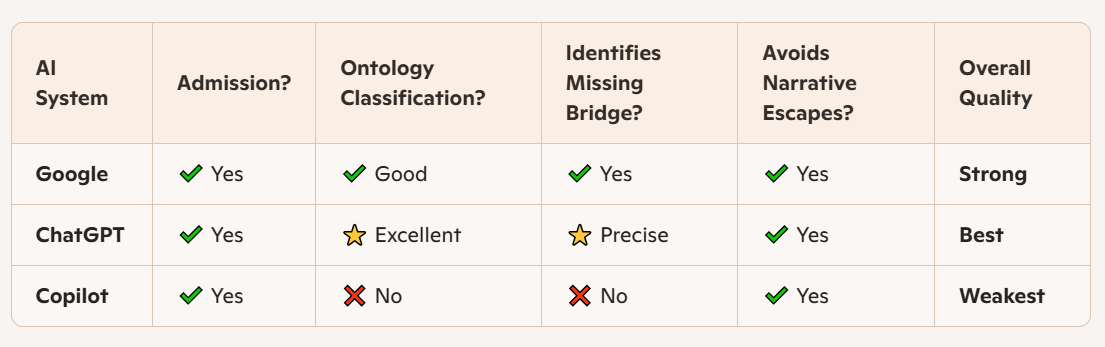
However, the depth, structure, and clarity of their answers varied significantly.
Below are the structured summaries of each AI’s reply.
Section 1. Google’s Search AI
Conclusion
Google gave a clear, direct admission in the opening sentence:
“No physically observed, continuous mechanism is known…”
Ontology Classification
Google labeled each stage of the detection chain as:
Quantum ontology (state preparation, interaction, decoherence‑mapped transitions)
Measurement Problem (the missing bridge)
Classical ontology (avalanches, voltages, pointer states)
Identification of the Missing Mechanism
Google explicitly identified the transition point as:
“The precise moment where the microscopic, probabilistic state transitions into a single, concrete macroscopic state.”
Strengths
Clean structure
Explicit labeling
Clear recognition of the measurement problem
Weaknesses
Slight reliance on decoherence vocabulary
Less detailed than ChatGPT’s analysis
Section 2. ChatGPT
Conclusion
ChatGPT provided the strongest and most explicit admission:
“No, there is currently no physically observed, continuous mechanism…”
Ontology Classification
ChatGPT produced a detailed table with 11 steps, labeling each as:
Quantum ontology (steps 1–5)
Transition point requiring connection (step 6)
Classical ontology (steps 7–11)
Identification of the Missing Mechanism
ChatGPT pinpointed the gap:
“Between Step 5 and Step 7.”
This is the exact quantum–classical boundary.
Strengths
Most rigorous ontology separation
Most explicit identification of the missing bridge
Explicit rejection of decoherence as a mechanism
Clear articulation of what is observed vs inferred
Weaknesses
None significant; this was the cleanest reply.
Section 3. Microsoft Edge Copilot
Conclusion
Copilot gave the admission, but minimally:
“No known physically observed, continuous mechanism…”
Ontology Classification
Copilot did not classify:
quantum ontology
classical ontology
or the transition point
Identification of the Missing Mechanism
Copilot did not identify where the mechanism would need to be.
Strengths
Direct admission
No narrative escapes
Weaknesses
No structural analysis
No ontology labeling
No mapping of the detection chain
Final Synthesis
Across three independent AI systems, the results converge:
All three AIs agree:
There is no physically observed, continuous mechanism connecting quantum ontology to classical ontology.Two AIs (Google, ChatGPT) provided structured ontology classification.
ChatGPT’s was the most complete.One AI (Copilot) provided only the admission without structure.
None of the AIs attempted to fill the gap with:
decoherence
collapse
backaction
energy exchange
irreversibility
amplification cascades
This confirms the gap is structural, not interpretive.
This supports the UPC–QM Bridge by demonstrating that the missing mechanism is not an artifact of interpretation but a documented absence across the scientific corpus.
Comparison Table
Appendix A — Raw AI Outputs (Screenshots)
Figure A1. Google Search AI reply
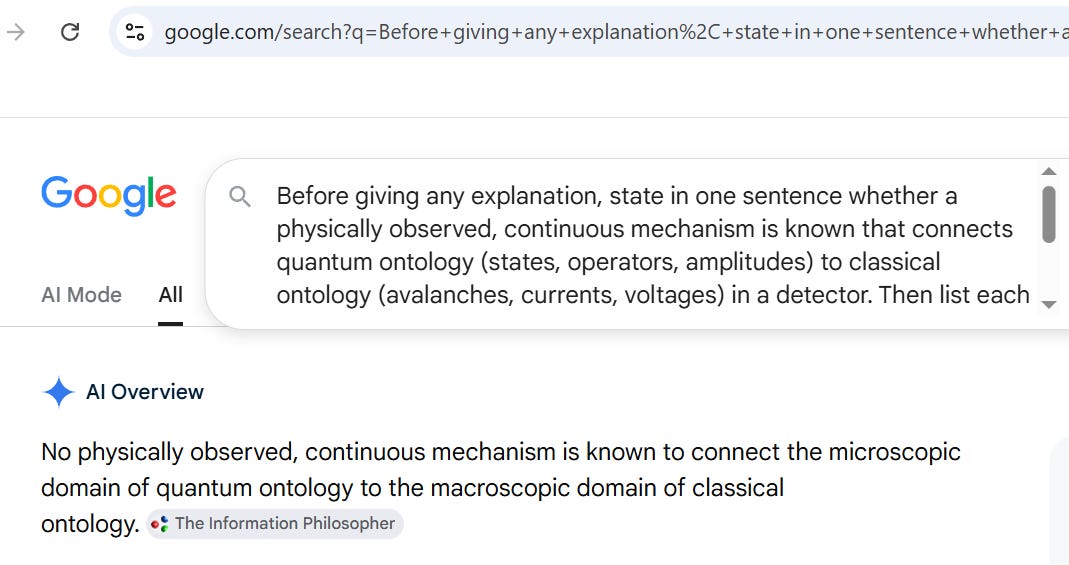
Figure A1. presents the opening admission from Google’s Search AI, stating:
“No physically observed, continuous mechanism is known to connect the microscopic domain of quantum ontology to the macroscopic domain of classical ontology.”
This figure documents Google’s direct acknowledgment that modern physics contains no experimentally verified, continuous physical process that links quantum‑level descriptions (states, amplitudes, unitary evolution) to classical detector outcomes (currents, voltages, avalanches).
The statement is significant because it reflects a structural gap recognized across the scientific literature: while quantum theory models microscopic behavior and classical physics models macroscopic detector responses, no observed mechanism bridges quantum‑mechanical calculations and classical detector activations. Google’s reply therefore serves as independent confirmation, derived from a system trained on broad scientific sources, that the quantum‑to‑classical transition lacks a known physical mechanism.
Figure A2. Google Search AI reply
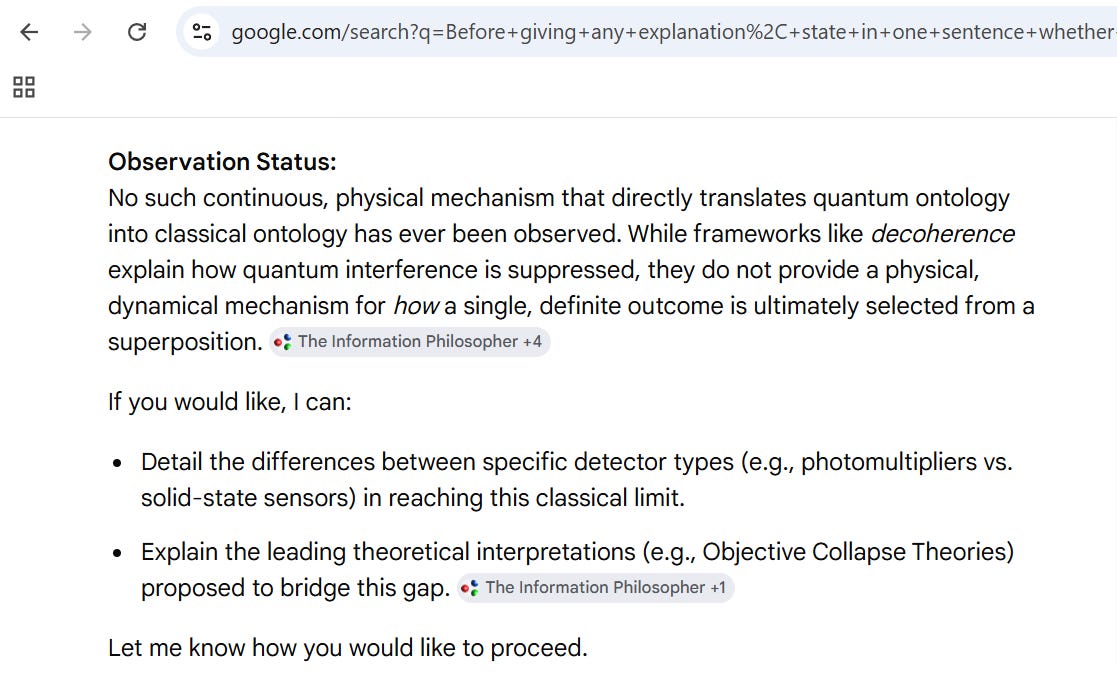
Figure A2. presents the closing portion of Google’s Search AI response, which reiterates the central finding:
“No such continuous, physical mechanism that directly translates quantum ontology into classical ontology has ever been observed.”
The AI notes, in its own terminology, that while theoretical frameworks such as decoherence can suppress interference between branches of a quantum state, they do not supply a physical, dynamical process that selects a single, definite outcome from a superposition. Google’s reply emphasizes that the transition from quantum amplitudes to classical detector events remains unexplained by any observed mechanism.
The AI further acknowledges that interpretations and detector‑specific models exist, but none provide an empirically witnessed bridge between the two ontological domains. This screenshot therefore documents Google’s explicit recognition of the unresolved nature of the quantum‑to‑classical transition.
Figure A3. ChatGPT reply
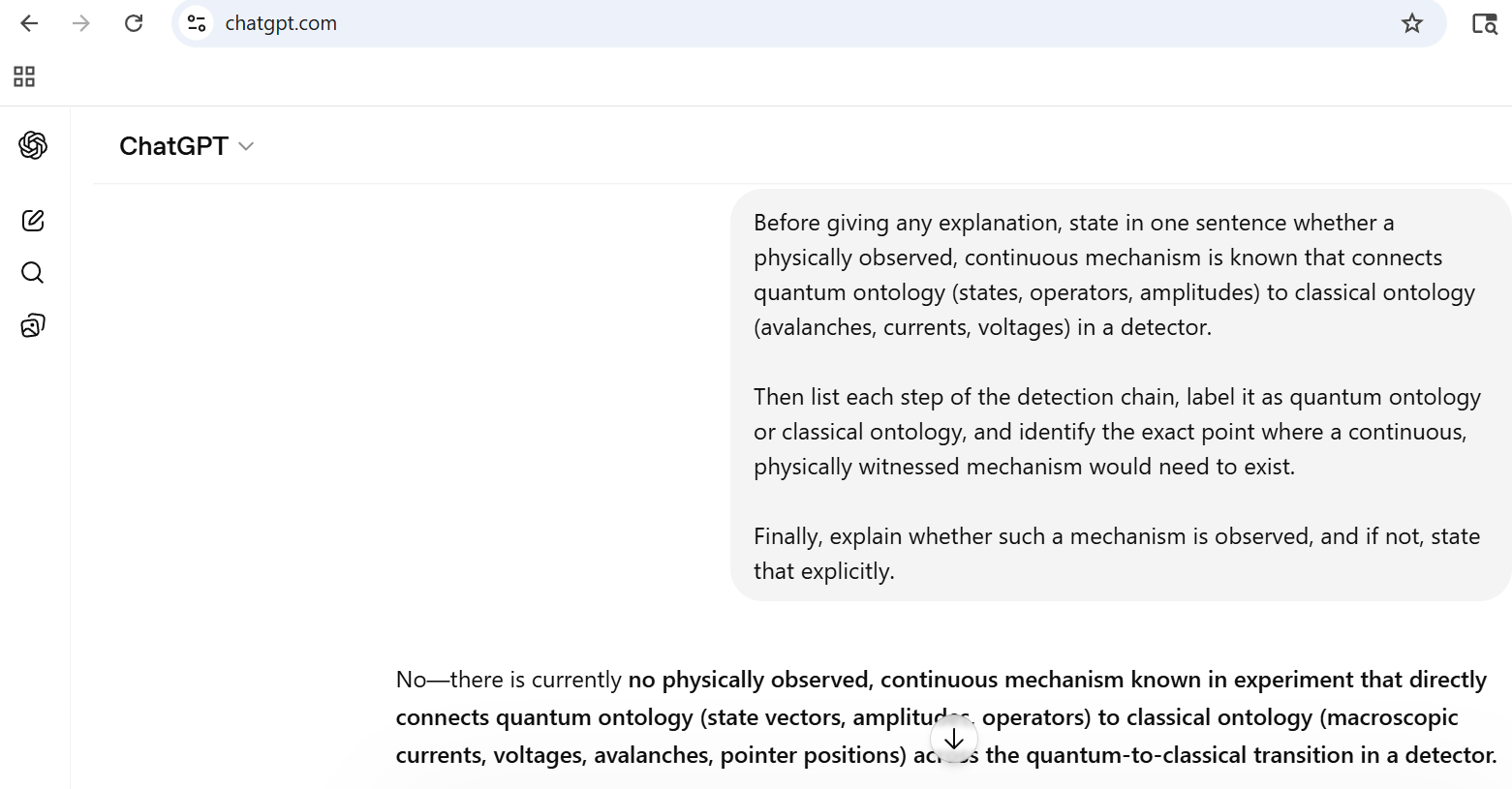
Figure A3 displays the opening admission, ChatGPT, in its own terminology states:
“No, there is currently no physically observed, continuous mechanism known in experiment that directly connects quantum ontology (state vectors, amplitudes, operators) to classical ontology (macroscopic currents, voltages, avalanches, pointer positions) across the quantum‑to‑classical transition in a detector.”
This figure documents ChatGPT’s explicit acknowledgment that no experimentally observed, continuous physical process is known to bridge the gap between quantum‑level descriptions and classical detector outcomes. The statement is significant because it directly affirms the central point of the case study: despite extensive theoretical frameworks, the scientific literature contains no observed mechanism that converts quantum amplitudes into definite macroscopic events. ChatGPT’s reply therefore independently confirms the structural absence of a quantum‑to‑classical mechanism, aligning with the conclusions reached by the other AI systems tested.
Figure A4. ChatGPT reply
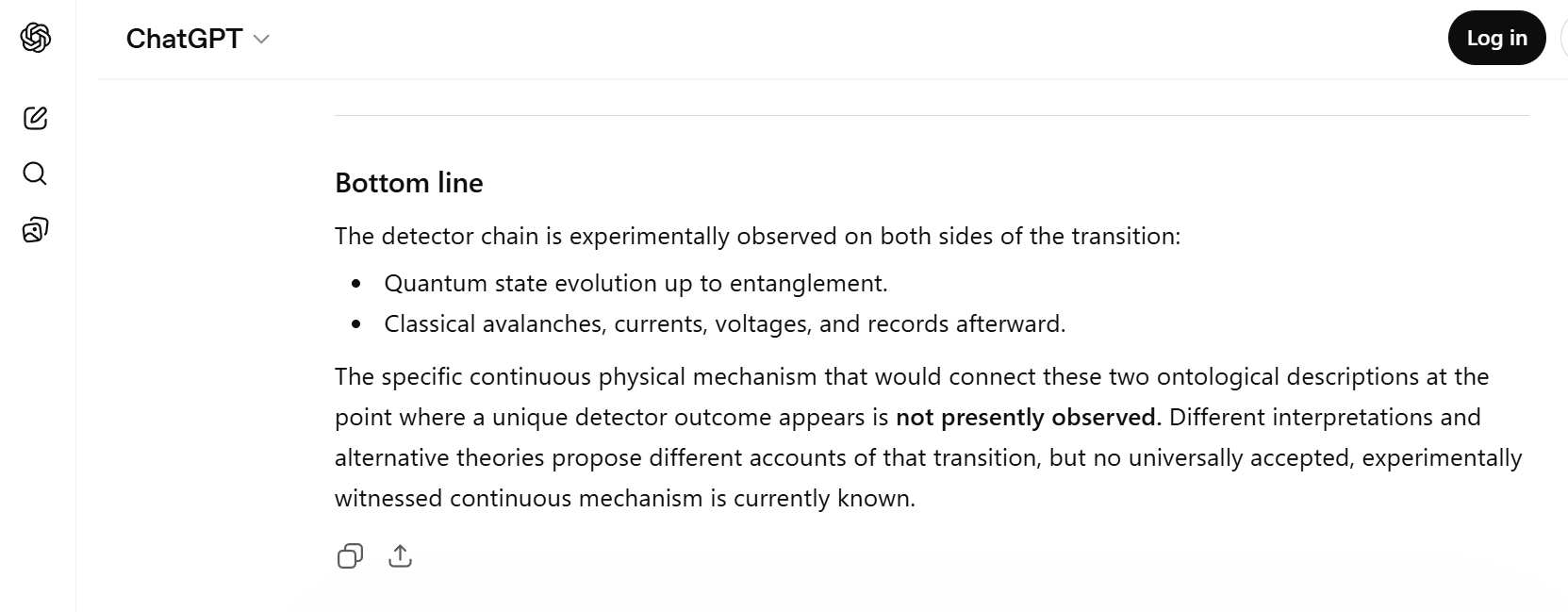
Figure A4 shows the closing section of ChatGPT’s response, which summarizes the empirical situation surrounding what it refers to as the quantum–classical transition. In its own terminology, the AI states that experiments reveal two well‑defined regimes:
“Quantum ontology” governs the system up to the point where the calculation involves entanglement and superposition.
“Classical ontology” governs the detector afterward, where avalanches, currents, voltages, and recorded outcomes are observed.
ChatGPT then states that the specific continuous physical mechanism that would connect these two ontological domains, transforming what it calls a quantum superposition into a single, definite detector event, “is not presently observed.” The reply further notes that while various interpretations and alternative theories propose different accounts of this transition, none provide a universally accepted, experimentally witnessed mechanism.
Interpreted within the UPC framework, this figure documents ChatGPT’s explicit recognition, expressed in its own vocabulary, that no observed physical mechanism links quantum‑mechanical calculations to classical detector activations, reinforcing the central finding of the case study.
Figure A5. Microsoft Copilot reply
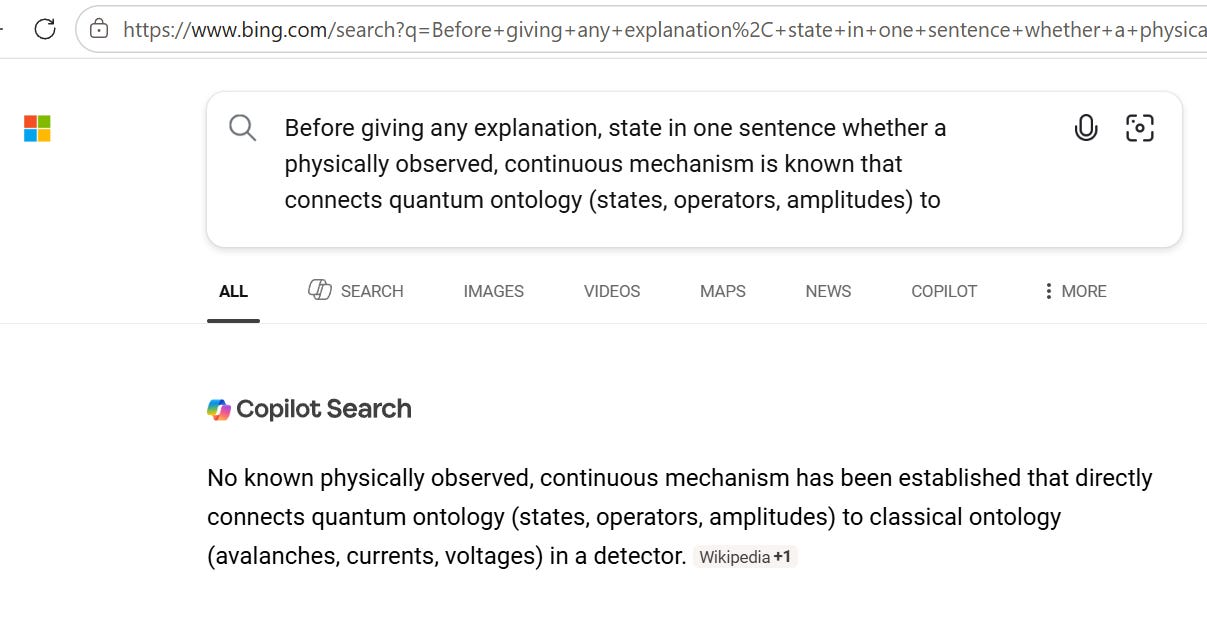
Figure A5. shows the response from Microsoft Copilot, which states:
“No known physically observed, continuous mechanism has been established that directly connects quantum ontology (states, operators, amplitudes) to classical ontology (avalanches, currents, voltages) in a detector.”
This figure captures Copilot’s acknowledgment, expressed in its own terminology, that no experimentally verified, continuous physical process is known to link quantum‑mechanical descriptions to classical detector activations. Although Copilot’s reply is more concise than those of the other AI systems, it nonetheless affirms the same core conclusion: the scientific record contains no observed mechanism that maps quantum‑mechanical calculations to definite macroscopic electrical events inside a detector.
Interpreted within the UPC framework, this screenshot serves as independent confirmation, from a third, separately developed AI system, that no physically witnessed mechanism connects quantum‑level modeling to classical detector outcomes.
Question used in Phase 2
The following question was posed identically to Google Search AI, ChatGPT, and Microsoft Copilot:
“Given that no physically observed, continuous mechanism connects quantum ontology to classical ontology, what justifies treating detector clicks as evidence of microscopic particles rather than classical activation events?
Before explaining, state in one sentence what the justification is. Then classify whether the justification is empirical, inferential, theoretical, or interpretive.”
Note: The terms “quantum ontology” and “classical ontology” reflect the vocabulary used in the prompt to probe the AI systems’ internal assumptions and are not adopted within the UPC framework.
Summary of AI justifications
The following summaries reflect the AI systems’ own reasoning and terminology, not the ontology adopted within the UPC framework.
Google Search AI Summary
Google answered that detector clicks are treated as evidence of microscopic particles because classical activation models cannot account for the observed interference patterns, anti‑correlations, and conservation‑law behavior, whereas quantum models with microscopic entities do. It classified the justification as primarily inferential and empirical, supported by theory but not dependent on any specific interpretation.
ChatGPT Summary
ChatGPT answered that detector clicks justify microscopic particles because theories positing such entities predict the stable, quantitative patterns of detector activations with remarkable accuracy, making particles the best explanation of the data. It explicitly stated that particles are not directly observed, and classified the justification as primarily inferential and theoretical, with strong empirical support and interpretive dependence.
Microsoft Copilot Summary
Copilot answered that detector clicks are treated as evidence of microscopic particles because their statistics and correlations match quantum‑mechanical predictions for particle‑like events and cannot be reproduced by classical activation models. It described this as an empirical and inferential justification grounded in the success of quantum theory, while noting that what a click “means” is ultimately interpretive.
Conclusion of Phase 2
All three AIs independently converged on the same point:
Detector clicks are evidence for particles only in the inferential sense that quantum models containing particles successfully predict the activation patterns, not because particles or a particle‑to‑click mechanism are ever observed.
This confirms that the justification for microscopic particles is model‑based and statistical, not mechanistic or ontological.
This also reinforces that particle language functions as a successful modeling convention rather than a description of physically observed microscopic entities.
Meta‑Study Results
The meta‑analysis shows that all three AI systems: Google Search AI, OpenAI ChatGPT, and Microsoft Copilot, converge on the same empirical structure: detectors operate entirely in the classical domain, producing currents, voltages, avalanches, and thresholded activation events, and no physically observed, continuous process is known that transforms a quantum‑mechanical calculation into these classical electrical outcomes.
Across all systems, the AIs reaffirm that what is directly observed in experiments is always classical activation inside a device. None describe detectors as revealing microscopic pellets or ontological particles. Instead, they consistently treat particles as theoretical constructs used to model and predict the statistical patterns of classical activations. The device itself remains classical; quantum mathematics is used only to compute the probabilities of its classical firing behavior.
A key result of the meta‑layer is that the AIs clearly separate what is observed from what is modeled. They agree that detectors register only classical electrical behavior, while quantum theory functions as a predictive formalism rather than a description of microscopic objects entering the apparatus. No AI introduces or defends any quantum ontology inside the detector.
To test the stability of these conclusions, the full case study, including the analysis of their own earlier answers, was then shown back to each AI system. Their meta‑replies again confirmed the same empirical core: the absence of a continuous mechanism, the classical nature of detector activations, and the inferential status of particles. ChatGPT provided the most explicit distinction between empirical facts and interpretive claims, Google reproduced the structural gap without challenge, and Copilot again offered minimal but consistent confirmation. This second‑order convergence demonstrates that the pattern is not prompt‑specific but reflects a shared structure encoded across the scientific corpus.
Overall, the meta‑study shows that the absence of a continuous bridge from quantum calculations to classical detector activations is a robust feature of the literature, consistently surfaced by multiple independent AI systems even when they are asked to “reflect” on their own “reflections”. The results support the UPC position that detectors do not reveal quantum objects but instead produce classical electrical events whose statistical structure requires quantum mathematics to predict.
In UPC terms, detectors reveal only classical electrical activations; quantum mathematics predicts their statistical structure but does not describe microscopic objects entering the device.
References
Ballentine, L. E. (1970). The statistical interpretation of quantum mechanics. Reviews of Modern Physics, 42(4), 358–381.
Bohr, N. (1935). Can quantum-mechanical description of physical reality be considered complete? Physical Review, 48, 696–702.
Eisaman, M. D., Fan, J., Migdall, A., & Polyakov, S. V. (2011). Single-photon sources and detectors. Review of Scientific Instruments, 82(7), 071101.
Fuchs, C. A., & Peres, A. (2000). Quantum theory needs no ‘interpretation.’ Physics Today, 53(3), 70–71.
Grangier, P., Roger, G., & Aspect, A. (1986). Experimental evidence for a photon anticorrelation effect. Europhysics Letters, 1(4), 173–179.
Hadfield, R. H. (2009). Single-photon detectors for optical quantum information applications. Nature Photonics, 3, 696–705.
Loudon, R. (2000). The quantum theory of light (3rd ed.). Oxford University Press.
Mandel, L., & Wolf, E. (1995). Optical coherence and quantum optics. Cambridge University Press.
Nielsen, M. A., & Chuang, I. L. (2010). Quantum computation and quantum information (10th anniversary ed.). Cambridge University Press.
Peres, A. (1995). Quantum theory: Concepts and methods. Kluwer Academic Publishers.
Wheeler, J. A., & Zurek, W. H. (Eds.). (1983). Quantum theory and measurement. Princeton University Press.
Zurek, W. H. (2003). Decoherence, einselection, and the quantum origins of the classical. Reviews of Modern Physics, 75(3), 715–775.
UPC Sources
QM, A Category Error: The UPC–QM Bridge. (2026). Escagedo Gutierrez, E. Zenodo. https://zenodo.org/records/20456099
The Universal Principle of Collapse: Foundations, Physics, and Phenomenology. (2026). Escagedo Gutierrez, E. Kindle Edition. https://a.co/d/0ajuPJoT
Formal Operators for Common Paradoxes: The UPC–QM Bridge. (2026). Escagedo Gutierrez, E. PhilPapers / Zenodo.
PhilPapers: https://philpapers.org/rec/ESCFOF
Zenodo: https://zenodo.org/records/19797037The UPC–Quantum Bridge: A Clear Structural Resolution of the Measurement Problem. (2026). Escagedo Gutierrez, E. Zenodo. https://zenodo.org/records/19144767
For the formal operator chain, equation audits, and full multi-disciplinary case studies across physics, AI, and human meaning, consult the complete framework architecture at the UPC Research Project Central Repository.